





















The German healthcare system is facing profound changes. Existing structures are reaching their limits in the face of rising costs, a shortage of skilled workers, and demographic developments. Digitalization and automation are enabling the first steps toward greater efficiency, but a sustainable medical ecosystem also requires new hardware in the form of wearables, i.e., portable devices. But how can miniaturization, networking, and reliable data security be reconciled? Here are a few tips on how to make the development process promising.
Until now, medical care has been based primarily on a reactive logic: diagnostic or therapeutic measures are only taken when symptoms appear and problems manifest themselves. From a health economics perspective, this is neither efficient nor sustainable. Accordingly, the OECD is pushing for prevention and continuous monitoring to be strengthened.
Mobile hardware enables a paradigm shift
The technological key to this lies in wearables and mobile measurement systems that enable vital signs to be recorded in real time – even outside hospitals and doctors' offices. These devices not only provide snapshots of patients' health status, but also deliver continuous data trends. This opens up completely new treatment methods: the larger database provides machine learning models with the basis for determining individual baselines, so that in the future, even subtle, temporary deviations that indicate an increased risk in the future can be detected.
Improved patient management helps to stop or at least slow down negative developments in chronic diseases and prevent acute incidents – a quality gain for those affected. Early intervention also allows acute cases to be treated more effectively. This not only increases the probability of survival, but also reduces the scope and duration of treatment, thereby helping to relieve the burden on hospitals.
In addition to improved mobility and ease of use, there is another decisive factor that contributes to acceptance among patients and users: the protection of data security and privacy. This is also required by regulatory requirements. In addition to the General Data Protection Regulation, these are also enshrined in the Digital Care Act (DVG) and the EU Medical Device Regulation (MDR), for example.
Basic requirements
However, cybersecurity and privacy are not "add-ons" that can be added at the end of development. Instead, they must be considered and taken into account from the outset – alongside all other requirements for miniaturized, wearable devices. This makes the development process for MedTech electronics and hardware considerably more complex. The most important guidelines include:
- Integration and miniaturization (system-in-package – SiP, modules);
- Energy efficiency as a top priority;
- Safety by design at the hardware level;
- Functional safety as a basic principle;
- General standards for technical devices;
- Medical device-specific process standards.
Challenging development
The development of wearables differs fundamentally in some respects from the development of stationary devices. First and foremost among these is the difficulty of combining high-precision analog technology (ECG signal) with high-frequency digital technology (radio) in a very small space without them interfering with each other. The need for in-depth expertise in medical device-specific electronics development, for example to implement standards from the IEC 60601 series, comply with electromagnetic compatibility (EMC) requirements, or ensure a high level of reliability, also represents a significant barrier to entry. Resource bottlenecks may also arise if there is a lack of specialized hardware engineers in-house.
Errors in the development process can have fatal consequences. If regulatory requirements are not met, there is a risk of approval being refused, i.e., CE marking according to MDR will be refused due to non-compliant hardware (e.g., due to EMC problems). There is also a risk of spiraling costs if multiple iterations of hardware revisions are required. These drive up development costs and significantly delay market entry.
Success with external partners
A profitable strategy for avoiding the risks described above is to involve an experienced partner who can use their specific expertise to ensure targeted, standards-compliant, and market-driven development.
Manufacturers are advised to select partners who:
- Take standards compliance into account right from the first circuit diagram
- Demonstrate expertise in safety-critical electronics
- Take an integrated approach to hardware and software development
- Plan for testability and validation early in the development process
- Actively incorporate MTBF optimization into the architecture
This is the only way to ensure that the development partner meets the above-mentioned objectives. Partners with an interdisciplinary approach—i.e., with their own expertise in software, cloud connectivity, IT security, and regulatory affairs—can significantly reduce the workload on development teams and minimize risks.
360° approach to development
The EDAG Group relies on a comprehensive development strategy based on broad expertise. In order to achieve the best possible results, specialists in requirements analysis and circuit and layout design work together with colleagues in prototype construction, testing, and verification, as well as experts in approval support and series production. The interdisciplinary approach also ensures that hardware developers work closely with software, cloud, and regulatory affairs specialists from the outset. They are all united by the goal of delivering not just an isolated circuit board, but a functioning subsystem for the entire ecosystem.
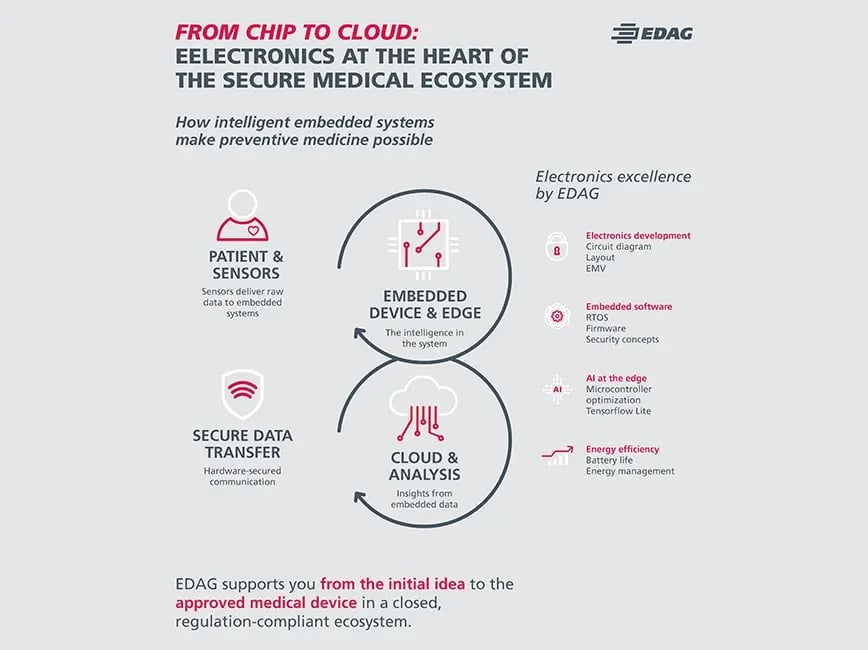
Electronics development provides the basis for safe portable medical devices – and thus for a safe medical ecosystem.
Our experts can transfer their knowledge and experience from large interdisciplinary projects, such as those in the automotive industry, because both sectors have the highest requirements for reliability, EMC, and functional safety. The development processes comply with the ISO 13485 (quality management for medical devices) and IEC 62304 (software life cycle) standards. This verifiable quality simplifies approval at the end of development. Experience with ISO 26262 (automotive functional safety) and the fundamental standard IEC 61508 is also transferred to medical technology. This enables the development of hardware architectures that are designed from the outset for fault tolerance, redundancy, and controlled malfunction.
The development experts also pursue a holistic, human-centered approach. This means that they not only develop the electronics, but also consider the overall system consisting of the patient, device, and ecosystem. Their expertise in UX design and ergonomics ensures that the devices are accepted and used correctly by the target group. EDAG experts address any concerns regarding data security and privacy through their in-depth understanding of cybersecurity (ISO 27001, TISAX) and data protection (GDPR). They build security into the hardware level, e.g., with hardware security modules, thus creating the technical basis for trust.
An essential aspect for marketability lies in the approval of prevention solutions: EDAG supports you in the approval process according to DiGA or MDR in order to pave the way for reimbursement and thus for patients.
Use case "μCardio-12 Secure"
One example of the miniaturization of medical devices is the conversion of a stationary 12-channel ECG monitor into a variant for mobile clinical use. The developers took on the task and developed a comprehensive concept.
In doing so, they had to meet challenging specifications. Weight and size had to be significantly reduced without compromising measurement quality. Another key target was sufficient battery life.
In addition, a comprehensive focus on security had to be taken into account during the electronics development phase. This included the selection of components, PCB design, and firmware programming.
The effort required for security and certification is considerable—but it is non-negotiable in order to ensure trust, compliance, and ultimately successful treatment. All in all, this integrated concept provides a comprehensive roadmap for the development of a clinically approved, telemedicine-enabled, and fundamentally secure 12-channel ECG system.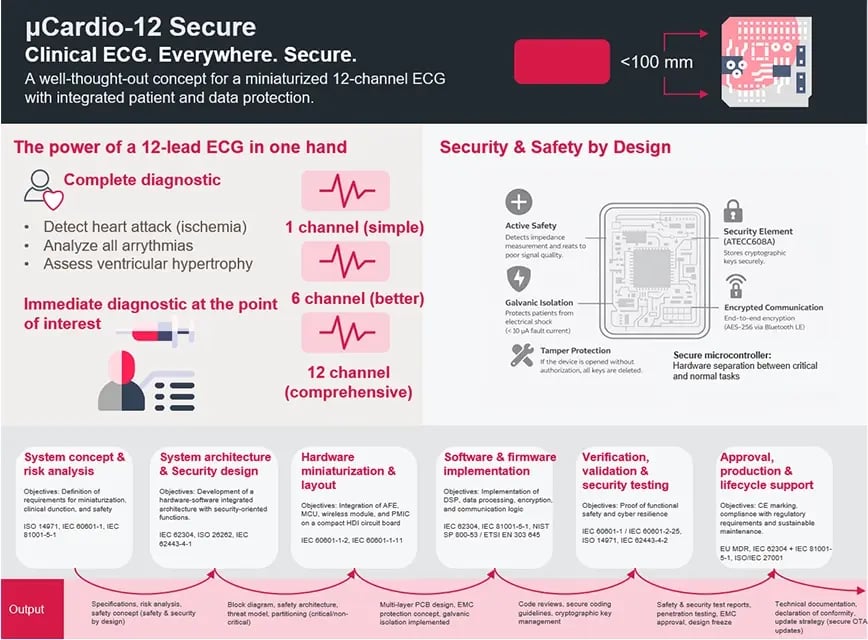
The concept of a miniaturized 12-channel ECG shows the extensive challenges that must be overcome from the initial idea to approval.
Are you also facing the challenge of expanding your portfolio to include portable, connected, and secure wearables and need support in electronics development? Then talk to Sinem Atilgan, Specialist Consultant for Digital Transformation, Tobias Schunk, Project Manager Software & Digitalization, or Michael Kelnberger, Business Development Medical Devices at EDAG, about opportunities for cooperation.
And download our white paper "Secure Mobile Hardware for Clinical Use" right here. Here you will find further details on how the development process can be designed to avoid any problems with approval. In addition, the detailed description of the "μCardio-12 Secure" use case provides an example of how cybersecurity and privacy can be anchored in the development process.