






















When development teams today work on shaving off the last tenth of a second or the last percentage point of stability, they often encounter a seemingly paradoxical phenomenon: despite additional functions and increasingly powerful actuators, driving dynamics plateau.
The reason rarely lies in the hardware. More often than not, it is the lack of overarching coordination. Individual controllers optimize in parallel—but not in concert. The consequences are well known: run-to-run variance, oscillating interventions, unexpected mode changes, fragile calibrations, and late surprises during testing. In software-defined architectures, this state of affairs is no longer acceptable.
This article demonstrates how a Vehicle Motion Controller (VMC) can act as an architectural lever to unlock untapped performance—not as yet another standalone product, but as an orchestration and arbitration layer within the software-defined chassis. The focus is on measurable effects, appropriate KPIs, and a development approach that is compelling both technically and economically.
Where Performance Is Lost Today
Modern chassis systems combine a multitude of functions with sometimes competing goals: stabilization, agility, ride comfort, lap time performance, and driving safety
Without centralized prioritization, interactions arise that compromise performance. Typical symptoms include diminishing marginal utility during demanding maneuvers, an inconsistent driving feel across varying conditions, and unexpected deactivation of assistance functions in edge cases.
Added to this is growing organizational complexity: More functions mean more interfaces, more dependencies, and exponentially increasing test scopes. This “complexity tax” directly affects the achievable driving dynamics—and limits them.
What “usable performance” really means
Traditional metrics like lap times fall short. What matters is what can be consistently achieved—and what the driver actually experiences.
Three KPIs describe this “usable performance” with particular precision:
- Handling: How precisely does the vehicle follow the driver’s intended inputs?
- Stability Margins : What reserves exist against oversteer or understeer?
- Driving Comfort (Intervention Intensity) : How efficiently and harmoniously do control systems intervene?
- Boundary conditions & Lane-changing behavior: Earlier and smaller interventions reduce overshoot and increase stability reserves. The vehicle remains predictable—even for less experienced drivers.
- Country roads: Coordinated blending of propulsion, braking, and steering forces ensures precise tracking while maintaining a smooth driving experience.
- Low-µ and Split-µ: Consistent target values reduce mode switching and settling times. Interventions become less frequent and more harmonious.
Supplemented by repeatability across different friction coefficients, loads, and tires, as well as fault tolerance under actuator degradation, a complete picture emerges.
To make these dimensions comparable, a composite Motion Efficiency Index is useful. It combines tracking accuracy, intervention quality, and energy efficiency into a consistent metric—across scenarios and development phases.
The Lever: Central Coordination via a VMC
A Vehicle Motion Controller acts as the central orchestration layer in the software-defined chassis. Instead of isolated optimization, it plans vehicle motion holistically and distributes setpoints consistently across all actuators.
This involves considering longitudinal, lateral and vertical movements, as well as rotations (yaw, roll, pitch), in conjunction. Constraints such as tyre performance, thermal limits and efficiency criteria play a central role in the decision-making process.
The VMC utilizes existing actuator systems. Low-level controllers and fallback mechanisms remain local. Functions requiring a global view are centralized—in particular, state estimation, 3D vehicle controller, control allocation, and actuator prioritization.
In practice, this represents a paradigm shift: functions request vehicle movements (e.g., yaw rate) rather than competing directly for control inputs. Conflicts are systematically resolved, not implicitly negotiated.
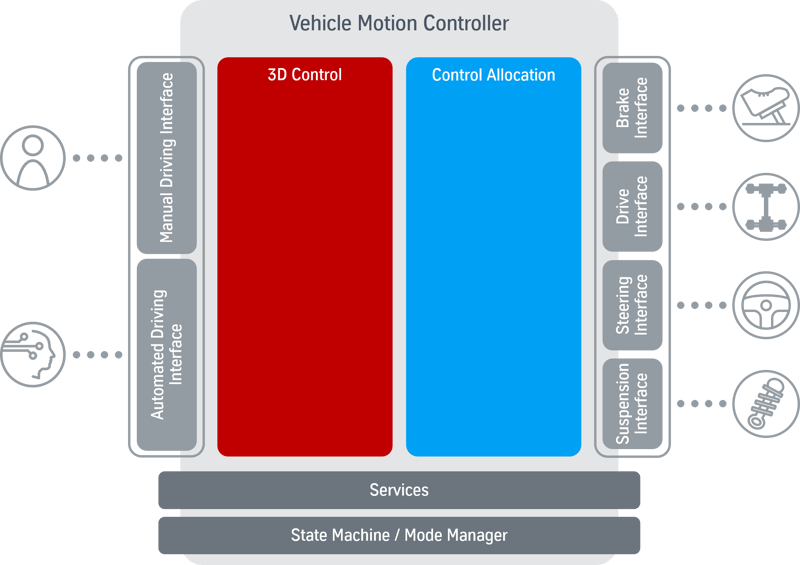
Vehicle Motion Controller Architecture
Measurable Effects During Driving
The advantages of centralized coordination are particularly evident in dynamic and critical scenarios:
The added value is also evident in the event of a failure: In the event of degraded actuator performance, the centralized view enables a targeted redistribution of forces—with defined and predictable degradation strategies.
Thinking more efficiently about development: Simulation first
Demonstrating these effects requires a clear validation strategy. Simulations in MiL, SiL, and HiL environments make it possible to cover large scenario spaces in a reproducible and cost-effective manner.
In particular, the highly realistic simulators and virtual development in the Zero Prototype Lab play a central role in validating functions early on and iterating efficiently. This approach is complemented by rapid prototyping in the vehicle, which enables the quick transfer and validation of new functions under real-world conditions.
Real-world driving tests remain essential—especially for fine-tuning and brand characteristics. However, the key lies in the interplay: simulation for breadth and comparability, vehicle testing for depth and validation.
Meaningful results emerge from structured comparisons—such as between traditional approaches and coordinated VMC intervention—as well as from consistent KPI evaluations across defined scenarios.
Economic benefits: Less complexity, higher throughput
Central coordination has an impact not only technically but also organizationally.
Calibration efforts decrease because targets and constraints are managed in one place. Test scopes become more manageable because combinatorial effects are reduced.
Replacing many individual software components with a centralized solution significantly simplifies the system architecture. This reduced level of complexity not only facilitates system management but also lays the foundation for efficient updatability—a key advantage for Software-Defined Vehicles.
Additional benefits result from more efficient interventions: lower energy consumption and reduced wear on tires and brakes.
Integration with a Sense of Proportion
A VMC is not a replacement for existing architectures, but rather a complement. Successful implementations follow a clear integration path—from concept and control allocation through virtual validation to vehicle validation.
System responsibility remains transparently distributed: central coordination is combined with local safety mechanisms. In collaboration with thyssenkrupp Automotive Technology, both control allocation expertise and comprehensive integration expertise are incorporated—with a focus on a resilient overall system rather than isolated solutions.
Conclusion: Performance is an architectural decision
The central question is no longer how much additional hardware is needed, but how existing systems work together.
A Vehicle Motion Controller lays the foundation for reproducible, robust, and efficiently usable performance—especially in complex and critical driving situations.
Anyone who thinks through the software-defined chassis consistently realizes: The greatest leverage lies in coordination. And that is precisely where it is decided how much performance a vehicle actually delivers on the road.
As leading partners, thyssenkrupp Automotive Technology and EDAG Engineering Group are pooling their expertise in attribute and system development to jointly shape the next generation of Vehicle Motion Control and drive forward holistic driving dynamics solutions. In doing so, they are specifically combining expertise in system development, chassis architecture, and software integration.
For questions regarding the implementation of a Vehicle Motion Controller, integration approaches in existing chassis architectures, or specific application scenarios, Jonas Grötzinger is available as the central point of contact at EDAG Group. At thyssenkrupp Automotive Technology, András Zoltán Csaba is your contact for topics related to system integration, chassis solutions, and industrial implementation.
If you would like to see a demo, please feel free to contact us - we’ll show you the system in action. Or register here for our free checklist on “VMC Readiness Check: 20 Checkpoints for Coordinated Vehicle Dynamics” and learn how centralized coordination measurably enhances vehicle dynamics, stability, and efficiency.
Want to take a deeper look?
How can Vehicle Motion Control translate the available actuator freedom into measurable vehicle-level performance? In our Vehicle Motion Control webinar, EDAG Group and thyssenkrupp Presta take a closer look at the technical approach – from 3D Motion Control and Vehicle State Estimation to Control Allocation and multi-actuator coordination. The session also explores simulation and vehicle results related to stability, agility, yaw and roll behaviour, and driver controllability.
Register for the free webinar and unlock the full potential of your chassis.