





















Electric vehicles stand for sustainability, efficiency, and quiet driving. But it is precisely this silence that poses risks: pedestrians and cyclists often notice the vehicles too late. Since 2021, UN ECE R138 has therefore mandated an Acoustic Vehicle Alerting System (AVAS) for electric and hybrid vehicles – a safety feature that also opens up new opportunities. After all, the sound of a vehicle can not only warn, but also convey emotions and brand values.
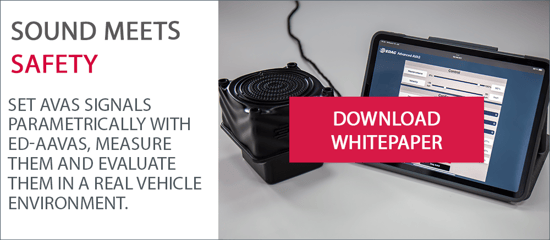
EDAG is seizing this opportunity: With the ED-AAVAS loudspeaker system, a development tool that combines hardware and software for AVAS, the company is developing intelligent, brand-specific sound solutions that perfectly combine safety, technology, and brand identity.
The challenge: When silent driving becomes a hazard
Imagine a busy city morning. People are crossing streets, bicycles are whizzing through traffic—but there is no sound of an approaching vehicle. Compared to vehicles with combustion engines, electric and hybrid vehicles move almost silently at low speeds . This lack of acoustic presence can quickly become a danger: People with visual or hearing impairments in particular rely on sound signals to detect hazards.
This is precisely where the legal regulations come into play: since July 2021, electric vehicles must be equipped with an AVAS system that generates artificial driving noises between 0 and 20 km/h. In the USA, FMVSS141 regulates similar requirements. However, EDAG sees this as much more than just fulfilling an obligation – it is an opportunity to use sound as a means of communication.
More than safety: sound as a brand ambassador
An AVAS is much more than a warning tone that simply has to comply with regulations. Although regulations require a continuous warning signal, they say little about how it should sound. This creates a conflict:
On the one hand, standards must be complied with, but on the other hand, manufacturers have leeway to use sound as part of their brand identity.
It can be specifically designed to evoke emotions and make the brand character audible. What does a sporty electric vehicle sound like in city traffic? How does a premium brand convey quality and value through acoustic signals?
EDAG's approach combines technical innovation with design and brand strategy. The technical flexibility of the ED-AAVAS system offers parameterizable adjustments, such as:
- Sound design in close coordination with the NVH and design departments
- Flexible configuration via software parameters
- Frequency and volume adjustment depending on speed or driving situation
- Integration of vehicle-specific parameters for an authentic brand experience
This turns a legal requirement into emotional added value: a sound that both protects and is recognizable.
Holistic development from a single source
In practice, this means that EDAG supports OEMs and suppliers from the initial idea to series production.
The process includes:
- Concept phase & sound development – Creative design and coordination with brand identity.
- System integration – Integration into the vehicle architecture, taking into account all legal requirements.
- Pre-homologation & testing – Acoustic evaluation and validation in accordance with UN ECE R138 and FMVSS141.
A practical example illustrates the added value: In the past, an international project required various companies from six different countries to work together in order to implement an AVAS system. This led to high coordination costs and long development times.
For this reason, EDAG finally decided to handle the entire development process itself – from the control unit and sound design to series integration. The result: a significantly shorter time to market, lower costs, and a consistent, brand-typical sound experience.
EDAG's technological strength: from hardware to software
The ED-AAVAS speaker system is based on an intelligent combination of robust hardware design and adaptive software architecture.
Technical highlights include:
- Adaptable control unit for flexible implementation in existing vehicle platforms
- Updatable software structure for adaptation to future regulations and brand strategies
- Compatibility with different vehicle segments – from compact cars to commercial vehicles
In the prototype phase, the ED-AAVAS loudspeaker system is a valuable tool for testing the functionality of the acoustic warning system at an early stage. One advantage is that this system can handle all settings from sound reproduction to modulation.
Brand communication meets safety
The AVAS system from EDAG creates emotional added value: it transforms every journey into an acoustic experience that audibly combines safety and brand identity.
The sound of a vehicle becomes the voice of the brand – individual, authentic, and forward-looking. This integration of acoustics into the brand strategy opens up new avenues in vehicle communication:
- Sound design as part of corporate identity
- Emotionalization of the driving experience
- Differentiation in the competitive environment
In this way, EDAG contributes to ensuring that quiet vehicles are not only perceived, but also understood and felt.
Conclusion: When innovation becomes audible
With the ED-AAVAS loudspeaker system, EDAG proves that technological requirements can become opportunities for brand innovation.
The result: greater road safety, stronger brand loyalty, and an emotional driving experience that lasts.
The vision is clear: tomorrow's vehicles should not only be quiet, sustainable, and connected—they should also be heard and experienced.
As a vehicle manufacturer or supplier, are you also facing the challenge of meeting the legal requirements for AVAS systems while creating a distinctive acoustic brand experience? Then talk to Tobias Krebs, NVH specialist at EDAG Engineering.
You can find out more about the journey from the initial sound idea to global homologation in our fact sheet "A holistic approach to AVAS" .
Download it here and discover how you can combine safety, efficiency, and brand identity acoustically with an integrated development approach.