



A device operates stably in the lab. The internal measurements appear clean. It is only during an electromagnetic compatibility (EMC) test conducted in accordance with standards that it becomes apparent that certain signals are more sensitive to electromagnetic influences than expected, or that the emissions are too high for the intended operating environment. What started as an unremarkable design decision can quickly turn into a problem with deadlines, approvals, and modifications.
The critical point: The problem rarely arises for the first time in the test lab. There, it merely becomes visible for the first time under realistic conditions. Anyone who waits until then to begin root cause analysis is working at a stage where modifications to the layout, layer stackup, cable routing, filters, or shielding are already significantly more complex.
This is exactly where EMC simulation comes in. It brings insights forward. This is relevant for new developments as well as for existing devices that are to be continued under new operating conditions, with additional wireless technology, or as variants.
Why EMC Often Only Becomes Apparent Late in the Process
A device often appears to function without any problems during assembly or in the first prototype. Less apparent at first are the electromagnetic interactions between the printed circuit board, cables, connectors, housing, and the operating environment.
In medical technology, two requirements always run parallel:
- The device must function reliably under electromagnetic influences.
- It must not affect other systems beyond defined limits.
If these two perspectives are not brought together until shortly before the compliance test, there is usually little room for maneuver. Adjustments to the layout, cabling design, filters, or shielding are still possible at that point, but they come too late in an already advanced development process.
There is also a second problem: The final test reliably shows whether a device passes. However, it does not automatically reveal the path through which interference is coupled in or out, nor does it indicate which measure would have the greatest effect.
What EMC Simulation Specifically Reveals
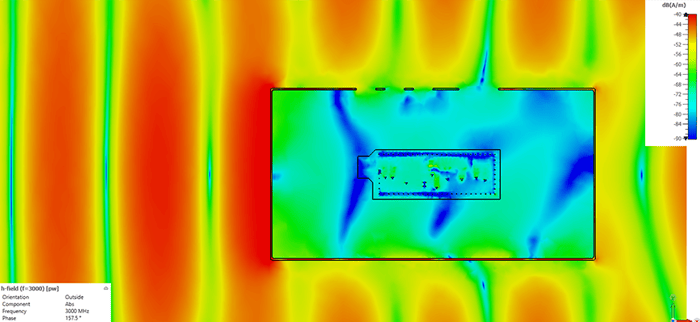
EMC simulation digitally models electromagnetic effects. Depending on the problem at hand, it can be applied to the entire system, to cables and connectors, or directly on the printed circuit board. In this way, it answers questions that often remain unresolved in late-stage testing.
For example, the following can be evaluated early on:
- which units are particularly sensitive,
- through which coupling paths interference enters or leaves the system,
- how layout, cable, filter, or shielding variations differ,
- how closely a design concept already aligns with the eventual test setup.
This does not replace standard-compliant verification. But instead of reacting only after receiving a test result, teams can use EMC simulation to understand in advance where risks arise and which modifications are likely to be effective.
Why examining existing devices is often particularly useful
This benefit of EMC simulation is frequently underestimated, especially for medtech products with long lifecycles. A device remains in the portfolio, the operating environment changes, a new variant is added, or additional requirements necessitate adjustments.
This does not automatically necessitate a redesign. Often, the first question is whether targeted measures—such as cable shielding, filters, layout details, or layer structure—are sufficient. Simulation helps answer this question more reliably before making hardware changes and entering test loops.
This is particularly relevant when production volumes are low, product portfolios must remain flexible to accommodate variants, or existing devices are to be further developed in a cost-effective manner.
Why This Is More Than Just an Efficiency Issue in Medical Technology
In medical technology, the issue does not end with passing a test deadline. When essential functions must remain stable, EMC must be included in risk and safety assessments. Standards such as IEC 60601-1-2 and the risk management framework outlined in ISO 14971 make it clear that electromagnetic influences must be evaluated early on and incorporated into the development process.
This is relevant for development, regulatory affairs, and product management because it makes decisions easier to justify. Risks become apparent earlier, variants can be compared more clearly, and the path to final validation is less likely to be marred by surprises down the line.
Conclusion: Understand sooner rather than having to make corrections later
EMC is not getting any easier in medical technology. Networking, wireless communication, denser electronics, and long product lifecycles continue to raise the bar.
EMC simulation helps identify critical areas earlier and evaluate countermeasures more effectively. Its value lies not in replacing real-world testing, but in enabling a development process that reduces the need for late-stage corrections.
Whether it’s a new development, a product variant, or the further development of existing devices: Our experts Oliver Neubauer, Senior Simulation Engineer, and Benjamin Reil, Team Leader, will help you evaluate and effectively leverage the potential of EMC simulation for your product portfolio.
Those who wish to explore the topic in greater depth will find the white paper “EMC Simulation for New and Existing Devices in Medical Technology,” which provides a concrete decision-making framework for new and existing devices, a yes/no self-assessment for your own portfolio, and a process model for the effective use of EMC simulation.