



















For years, the smart factory has been regarded as the model for industrial transformation. Sensors, IoT, data rooms, and AI promise production that optimizes itself, detects bottlenecks, and responds flexibly to new requirements. But the reality in many factories looks different. Brownfield data landscapes, a lack of standards, scarce resources, and parallel waves of innovation make it clear that the path to the smart factory is less a technological leap and more a systematic change.
Data is the beginning, not the solution
Valuable data sources have existed for years in many areas of production, but they remain isolated. Machines deliver measurement series, quality data is documented manually or recorded in Excel, and processes run in parallel in different systems. The data is available, but it does not speak a common language.
The central challenge is therefore not the collection of data, but its centralized use. Only when data is described uniformly, temporal relationships are correctly linked, and process steps are clearly identifiable does an overall picture emerge that can be used for optimization. Many companies underestimate this effort. They invest in sensors and dashboards without checking whether there is a consistent data logic that makes later AI scenarios possible in the first place.
In the smart factory, there is therefore no way around a structured data foundation. The question is not whether data exists, but whether it is consistent, reliable, and complete enough to build on and make decisions.
Modular instead of monolithic: Why rigid systems slow things down
Another bottleneck is created by historically grown system landscapes. Production IT has long been characterized by monolithic systems that map specific processes in a fixed manner. Every modification becomes a major operation, and every new use case requires its own project.
Modular architectures solve this problem. They make it possible to adapt individual functions independently of each other, add services, or integrate new AI models without destabilizing the overall system. This flexibility is crucial, especially in industrial environments where long life cycles meet fast innovation cycles.
A modern smart factory therefore needs more than just a technological upgrade. It needs a modular system in which hardware, software, data, and processes are designed for changeability. The factory of the future is not static, but flexible.
People remain a key factor
Despite growing automation, humans play a key role. They monitor critical processes, evaluate complex situations, and decide how to deal with deviations. The question is therefore not whether humans will be replaced, but how technical systems can support them in a meaningful way.
In the smart factory, new forms of collaboration between humans and technology are emerging. AI can recognize patterns, provide forecasts, or issue recommendations for action. However, the final assessment remains with qualified specialists who understand the production environment better than any model. At the same time, new tools must be designed to be understandable so that they create trust and decisions remain comprehensible. Transparency is more important than perfect precision.
Brownfield is the rule, not the exception
Many companies would like to start from scratch on a greenfield site. In reality, however, most plants consist of mature brownfield environments. Different generations of machines, control systems that have been adapted over the years, and varying levels of documentation are the norm. Smart Factory therefore means working with these conditions instead of ignoring them.
Typical starting situations in brownfield are:
- Machines with long life cycles and heterogeneous control systems
- Documentation that has been updated over many years and is not consistent everywhere
- Data stored in isolated applications or Excel files
- Differences between lines or plants that make standardized approaches difficult
- Retrofit concepts in which existing machines are specifically retrofitted technically and digitally in order to integrate them into modern production and data structures and add complementary sensors
- Integration layers that connect heterogeneous sources
This is precisely where pragmatic steps are crucial. Transformation does not begin with the perfect architecture, but with the first meaningful connection to existing systems. Solutions that make use of existing assets are particularly effective:
Smart Factory in brownfield means making targeted use of existing structures and data and expanding them further instead of replacing them. Added value is created where systems and data are connectable and where the next development steps can build on this, not through demolition and new construction.
The AI Factory: When production and data merge into one system
The next stage of development goes beyond pure digitalization. The AI Factory emerges where decisions are prepared on the basis of data and operational processes are continuously optimized. AI models analyze quality data, detect deviations at an early stage, simulate production scenarios, or prioritize maintenance measures.
It is crucial that this intelligence does not work in isolation. It becomes part of the production processes and acts in real time. This is where the value of clean data becomes particularly apparent. Without a reliable foundation, no robust forecast can be made. Without integrated systems, no recommendation can be implemented automatically.
The AI Factory is therefore not a single technical project. It is an organizational model that connects data, people, processes, and technology. Anyone who wants to take this step needs courage, clear goals, and the willingness to go through iterative learning processes. Many successful implementations start with small use cases that are quickly validated and systematically scaled.
What steps companies should now take toward the smart factory
The path to the smart factory is not a linear sequence of technologies. It is a learning process in which strategies, systems, and role models are gradually developed. The biggest mistake would be to wait for the perfect starting point. Progress comes from pragmatic steps that leverage existing strengths and test new opportunities in a targeted manner. A clear strategic framework, flexible architectural approaches, and the courage to make use of incomplete data form the basis for any further development. The key is not to do everything right immediately, but to move forward consistently, perform the analysis of experiences, and work through, optimize, and connect your own processes step by step.
Many companies today are at a point where it is clear that their production needs to become smarter, but the logical first step is not obvious. A series of measures that have proven themselves in almost all industries offer guidance:
- Make data visible: Before implementing new sensor technology or setting up AI models, it is necessary to have transparency about what data already exists, what quality it is, and how it is currently being used. Often, this overview alone provides a clear focus for initial use cases.
- Define pilot areas: Small, defined areas are ideal for quickly testing data structures, processes, and AI approaches. The insights gained serve as a blueprint for further production lines.
- Establish modularity as a principle: Basically, new tools, software modules, and interfaces should be expandable. Modularity prevents integration problems later on and creates an architecture that can grow in the long term.
- Involve employees early on: Know-how from production and maintenance is crucial for successful smart factory concepts. Involving people early on in the development process increases both acceptance and process quality.
- Prioritize use cases according to their benefits: Not every idea is worthwhile. The focus should be on applications that generate quickly noticeable improvements, for example through quality forecasts, process stabilization, or optimized cycle times.
- Consider scaling: A pilot is only valuable if it is transferable. Standards, reusable modules, and a clean data architecture ensure that solutions can be rolled out to other plants later on.
- Remain pragmatic: Brownfield is the norm. Different machine generations and incomplete documentation are not obstacles, but rather framework conditions. Those who accept this reality will find solutions that really work more quickly.
How EDAG supports companies on this path
The smart factory is emerging at the interface between engineering, production, software, and data. EDAG supports companies in establishing precisely this connection. This includes robust architectures, meaningful data models, optimized processes, retrofit strategies for brownfield environments, and solutions that bring people and technology together in a meaningful way. The goal is production that is more efficient, more flexible, and at the same time easier to control. We accompany you every step of the way.
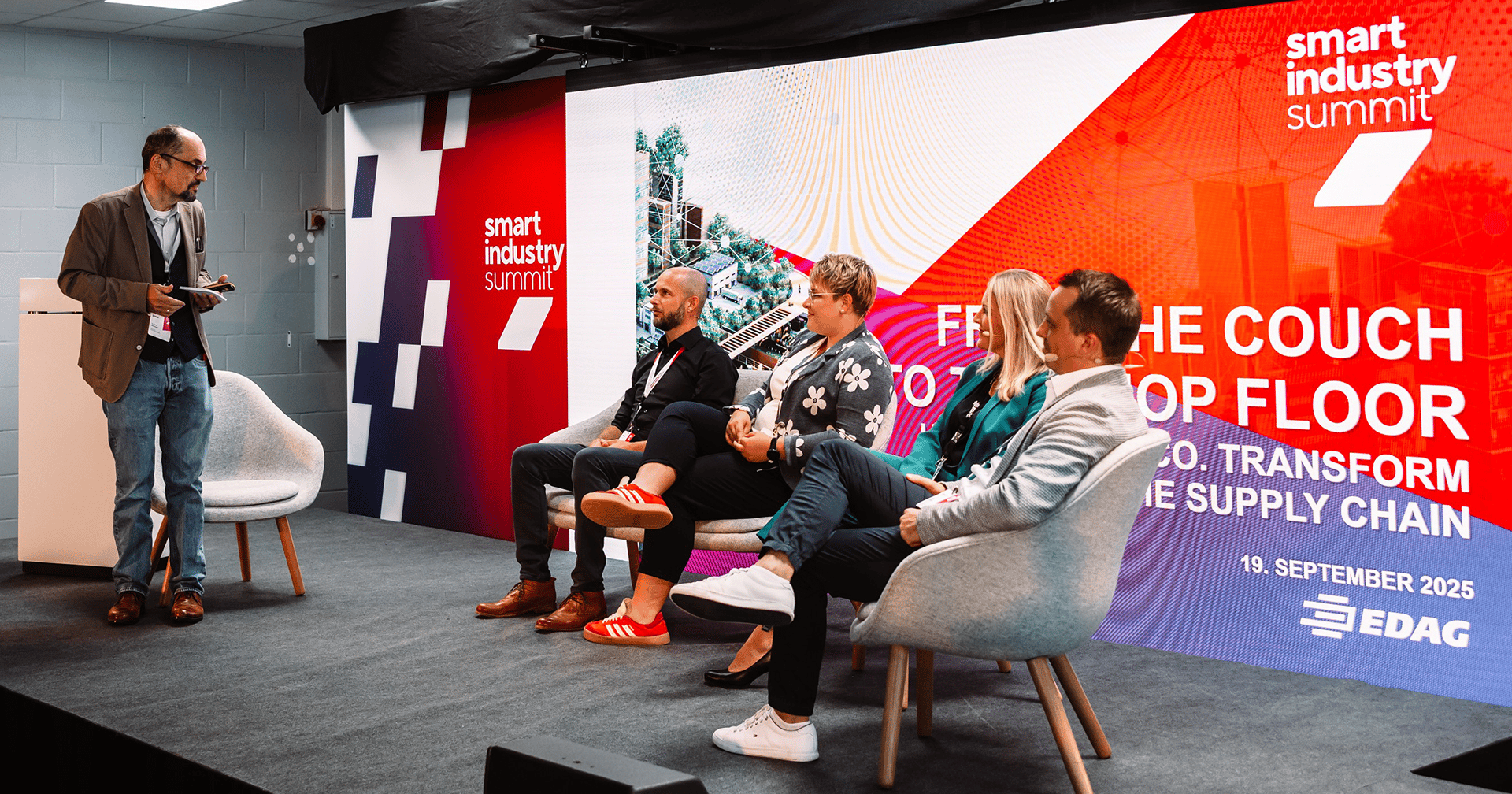
Want to dive deeper? Watch the "Smart Factory" couch talk recording
Gain exciting insights and perspectives from our experts on the topic of smart factories. In the recording, you will learn how data architectures, AI, and brownfield realities come together in practice and which developments will shape the coming years.
Participants in the couch talk:
- Dr. Sandra Maus (Head of Solution Advisory Supply Chain Management, SAP)
- Theresa Sinn (Head of Operational Excellence, EDAG)
- Mark Kramer (Head of Solutions and Services, EDAG)
- Christoph Schultheis (Head of Automation, EDAG)
- Dr. Frank Breitenbach (Moderation, Senior Expert Planning Methodology, EDAG)
Do you have any questions? Please contact our colleagues Mark Kramer and Dr. Frank Breitenbach.