




















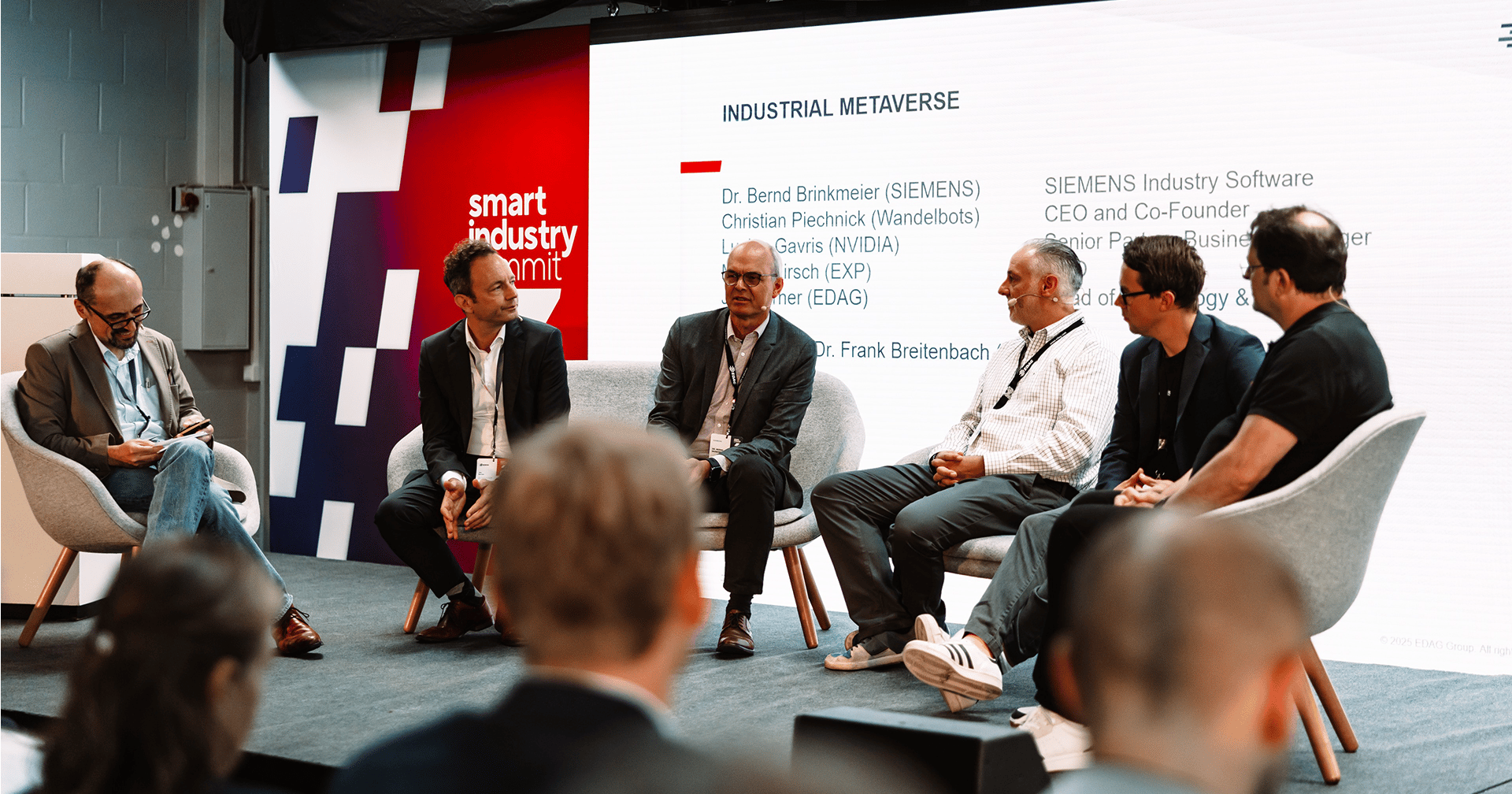
The Industrial Metaverse is no longer a vision of the future, but reality. Companies that use it now are shaping the production of tomorrow. At EDAG's Smart Industry Summit on September 18, 2025, renowned experts from industry discussed the state of the art in technology, specific business cases, and the strategic importance for Europe. Their message: The technology is mature, and initial use cases deliver a positive return on investment (ROI) within a few months. Companies that hesitate risk falling behind Asia and the US.
Why now? The technological turning point
The Industrial Metaverse brings existing technologies together and takes them to a new level. This is made possible by the software technologies and powerful computing capacities available today. Another decisive factor is artificial intelligence (AI). The combination of these factors results in qualitative progress. The following developments are driving the breakthrough:
- Genuine networked digital twins
Networked digital twins create dynamic virtual copies of real production environments and their processes at different levels, continuously collecting data to simulate, analyze, and optimize them.
- Artificial intelligence
AI models analyze complex data sets and extensive information in a fraction of the time it takes humans. They process billions of data points, identifying optimization potential more quickly and enabling more accurate predictions, predictive maintenance, quality improvements, and more efficient and intelligent control, among other things.
- Cloud-based computing power
This makes complex simulations of entire factories economically feasible. Ten years ago, this would have required several data centers.
- Collaborative platforms
Platforms such as Nvidia Omniverse connect teams and enable real-time workflows in 3D. They support cross-functional collaboration.
- Connectors
They extract data from legacy systems and proprietary tools, harmonize it, enable data transfer, and create the flexibility for successful implementations.
Three areas of application with measurable ROI
The economic situation of many companies is tense, and budgets are tight. The message from the discussion group was therefore clear: the industrial metaverse must be measured against robust business cases. The participants named three specific areas in which measurable added value is already being generated today:
1. Increased efficiency of brownfield plants
Digital twins test process variants of existing plants. AI algorithms evaluate hundreds of thousands of configurations and suggest optimizations. Even in complex applications, production increases of 10 to 15 percent are possible, software-based, without hardware modifications, reports one discussion participant. An example: In a production plant with five ABB robots, a digital twin was used to reduce the cycle time from 23 to 12.5 seconds within a week, without any physical intervention, solely through a software update. Output nearly doubled.
This means that brownfield optimization generates a fast ROI with calculable risk and creates organizational acceptance for more far-reaching transformation projects.
2. New production facilities: Reduce planning risks, shorten time-to-market
When planning new production facilities, engineers from different disciplines work in parallel on the digital twin. With the help of industrial AI, digital twins realistically map processes and facilities in a fraction of the time it would normally take. Virtual commissioning is possible earlier, and errors become visible at an early stage.
One discussion participant emphasized that if the simulation works, engineers can be 98 percent sure that the plant will also run in reality. This enables companies to make more informed investment decisions and reduce risks.
This means less risk, shorter ramp-up times, and greater predictability for projects.
3. Automation of complex assembly processes through reinforcement learning
Industrial assembly is considered difficult to automate, due to complex processes, diverse materials, and a high number of variants, among other factors. In reinforcement learning, the digital twin takes on the role of the environment in which AI can learn without risk. The digital twin is essentially the training room, and reinforcement learning is the learning mechanism. The AI calculates hundreds of thousands of possibilities and derives the optimal automation strategy from them. Tasks that are no longer computable for humans due to the variety of variants can be solved by trained AI models.
This means that the use of reinforcement learning to train AI enables the systematic, data-based development and optimization of complex assembly processes.
Photorealistic representation of complex interrelationships: Functional basics
Wherever systems go into operation and there is a high degree of networking with complex interrelationships, photorealistic representations and detailed 3D scenes are functionally essential. They generate synthetic training data for AI models and form the basis for computer vision in production, for example in quality inspection or pick-and-place tasks. At the same time, visualization facilitates collaboration between specialist disciplines and shortens feedback loops.
Strategic enabler instead of gimmick
Companies are under pressure to consistently align their investments with business benefits. Technologies without clear added value have no place. The industrial metaverse should not be misunderstood as a gimmick. It is an enabler of effectiveness and competitiveness, according to the tenor of the discussion.
Rethinking mindsets, structures, and responsibilities
Software has become one of the main drivers of value creation in industrial production. But as one participant in the discussion clarified, digital twins and industrial AI only unleash their potential if companies are willing to break new ground. In practice, there is often reluctance: instead of experimenting, new approaches are rarely pursued or awaited. According to the participants in the discussion, Europe sometimes lacks the necessary "hunger" to consistently test innovations. Yet the investment required to get started is manageable. Initial use cases start at EUR 30,000–50,000 and can generate a positive ROI after one to three months. Such pilot projects create trust, transparency, and a solid foundation for scaling, provided that the use case is clearly defined and the benefits are measurable.
The impetus to carry out initial projects can also come from the specialist departments: an initial use case demonstrates the added value, creates acceptance, and reduces reservations. The key insight is that networked digital twins are not 3D toys, but strategic tools with measurable economic benefits. The introduction of industrial AI and digital twins is also changing structures and roles in some cases. They require closer integration of development and production in the sense of design for manufacturing and raise new questions about responsibilities. Roles such as Chief AI Officer (CAIO) or expanded tasks in the CIO environment are gaining in importance in order to coordinate AI initiatives, steer data strategies, and anchor innovation sustainably in the company.
Europe's advantage: mechanical engineering expertise
A key finding of the discussion: Europe has an underestimated competitive advantage – deep engineering knowledge in mechanical engineering that has grown over decades.
International competitors use digital tools, but do not always have the necessary technical expertise in mechanical engineering to critically evaluate AI-generated results and interpret them in context. European mechanical engineers, on the other hand, contribute their accumulated manufacturing and process expertise. The decisive difference therefore lies less in the technology itself than in its qualified application and classification.
Europe has the expertise, infrastructure, and partner networks. What it lacks is the courage to take the first step, emphasized one participant in the discussion. Openness, partnerships, and working together on a shared vision will determine whether Europe stays ahead of the game.
Companies that embrace new technologies gain competitive advantages through efficiency, speed, and flexibility, even in difficult times. Size matters less than vision and strategy, one participant affirmed.
Call to action: "Act now or fall behind"
At the end of the discussion, the participants made a clear appeal to the audience: The industrial metaverse is not a promise for the future, but an enabler available today for more efficient collaboration, better product quality, and faster decisions. It is possible to get started even with small use cases and manageable budgets. The ROI often comes faster than many expect. The technologies are ready for use. Those who fail to act now risk being overtaken by competitors who are already using AI and virtual technologies productively.
The tenor was clear: start, try, scale – and thus actively strengthen Europe's industrial competitiveness.
Watch the entire discussion
Anyone considering investments in digitalization, digital twins, AI, or automation, or who needs to make the business case for the industrial metaverse internally, will gain deeper insights and hear experience reports in this Couchtalk.
Register here to access the full recording. Do you have any questions? Please contact our colleagues Jan Berner and Dr. Frank Breitenbach .
Participants in the couch talk:
- Dr. Bernd Brinkmeier (Head of Portfolio Development Product & Manufacturing Engineering, Siemens Industry Software)
- Lucian Gavris (Senior Partner Business Manager, Nvidia)
- Marko Hirsch (CEO, EXP Software)
- Christian Piechnick (CEO and Co-Founder, Wandelbots)
- Jan Berner (Head of Technology & Process EDAG PS/Feynsinn)
- Moderator Dr. Frank Breitenbach (Senior Expert Planning Methodology, EDAG PS)