



















Traditional robotics really shines where processes are stable and predictable. Parts are located at defined positions, procedures are repetitive, and changes occur only rarely. Things get more difficult as soon as reality becomes less orderly: components are positioned differently than expected, variants change more frequently, and processes must be adjusted on short notice. That’s when the effort required quickly increases.
This is precisely where Physical AI comes into play. The term may sound like futuristic technology, but at its core it describes a very practical capability: A robotic system perceives its environment via sensors, evaluates this information, and reacts to it in real time. Instead of simply following a fixed path, the system can handle deviations.
The key difference from traditional robotics lies not in the robot’s movement itself, but in its decision-making. While conventional systems can only react to predefined situations, the AI recognizes patterns in sensor data, assesses the current situation, and derives the appropriate action from it. This enables the system to handle deviations that were not pre-programmed for every single variant.
Physical AI extends traditional robotics to handle deviations
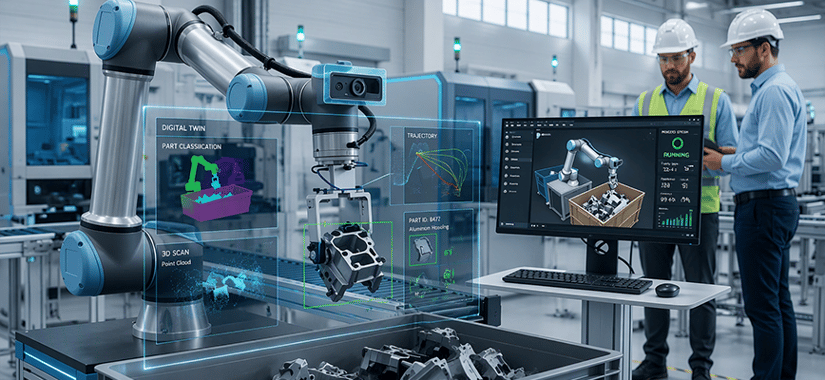
In traditional robotics, a sequence of steps is described in advance as completely as possible. This works well as long as the process is tightly controlled. Physical AI complements this logic wherever deviations occur. A typical example is grasping parts whose exact location is not known in advance. Image or point cloud data from a camera system then helps determine the position and calculate the appropriate grasping point.
It’s important to distinguish this from the hype. For many industrial applications, a fully AI-controlled robot isn’t necessary. In practice, a hybrid approach often makes more sense: stable process steps remain classically programmed, while dynamic subtasks are supplemented by sensors and AI. This is precisely what makes Physical AI attractive to companies. They don’t have to reinvent their automation, but rather expand it specifically where rigid logic reaches its limits today.
Many bottlenecks lie not in the robot itself, but in the architecture surrounding it
Anyone looking to introduce Physical AI into production quickly encounters a second reality: many robotic systems remain heavily tied to individual manufacturers’ ecosystems. Each platform comes with its own tools, its own operating logic, and its own interfaces. This complicates programming, support, expansion, and integration into existing production systems.
To reduce these dependencies, open, software-based platform approaches are gaining importance. They rely on standardized interfaces and reusable software modules rather than proprietary silos. The difference is significant: an isolated robot cell becomes a system that can connect with other applications, data sources, and user interfaces.
For companies, this is no minor detail. The more heterogeneous the robotics landscape is, the more important it becomes to have an architecture that does not veer into a new specialized solution with every expansion.
The Smart Way to Get Started Is Through Simulation
Many companies are interested in Physical AI but hesitate to get started. The reason is understandable: Before a solution goes live, time, money, and internal resources must be invested. If technical weaknesses or integration problems only become apparent during commissioning, the effort and costs quickly rise.
This is precisely where simulation demonstrates its added value. A digital proof of concept makes it possible to validate the interaction between robotics, sensor technology, and AI in a virtual environment before hardware is procured or production processes are adapted. This brings technical risks, integration efforts, and potential vulnerabilities to light early on, allowing them to be addressed in a targeted manner.
This is particularly crucial for Physical AI, as it involves the convergence of various technical components: perception, motion logic, operation, data flow, and often integration with existing systems. Attempting to resolve this complexity only once the system is in place unnecessarily increases the risk.
Physical AI is also transforming the engineering process
Open, software-based robotics approaches are also changing the way systems are developed and maintained. Modular software components and standardized interfaces make it easier to adapt, expand, and integrate functions into existing systems. Robotics is thus moving closer to the world of modern software development. Changes can be versioned more cleanly, tested in simulation, and rolled out into operation in a controlled manner.
This represents a significant advancement for production environments. A system no longer needs to be treated as a special case requiring major intervention every time an adjustment is made. New functions, user interfaces, or additional robotic systems can be introduced in a more structured manner. This is a considerable advantage, particularly in environments with variants, expansions, or increasing levels of automation.
Process data thus becomes a true production factor
As soon as robots sense their environment and react to specific situations, new data emerges from real-world operations. This data is not merely supplementary; it helps to better understand error patterns, improve processes in a targeted manner, and enhance future models with insights gained from actual use.
In an industrial setting, a clear distinction remains important: a production system does not independently adjust its behavior during operation. However, the data from the application is valuable for establishing subsequent training and optimization steps on a more solid foundation. This is precisely where one of the long-term differences between rigid automation and adaptive robotics lies.
From a Single Use Case to a Scalable Physical AI Architecture
A single Physical AI use case initially delivers concrete benefits. However, its long-term value is realized above all when the data, models, interfaces, and insights developed in the process can also be used for other applications.
This is precisely where metys, EDAG’s industrial metaverse platform, comes into play. metys connects existing engineering, production, and IT systems within a shared industrial context. Product, process, plant, and operational information becomes usable through its interconnections, without having to replace existing expert systems.
As a result, simulation, industrial AI, and physical AI are built on a shared, reusable foundation. New applications do not start from scratch but draw on existing structures, data, and relationships. This allows a successful pilot to be gradually carried over to additional workstations, cells, lines, and production areas.
Don’t think of Physical AI as a standalone project.
Learn how metys connects industrial data, engineering, simulation, and AI within a shared context, creating a scalable foundation for further applications.
→ Learn more about metys
“Dark Factory” Is a Vision of the Future, Not a Practical Starting Point
In the context of Physical AI, the term “Dark Factory” is also being used more and more frequently. This refers to a largely autonomous production process that operates without a permanent human presence. As a long-term vision, this is a relevant concept. However, it is too ambitious a concept for getting started with Physical AI.
An autonomous factory does not emerge simply by equipping individual robots with AI functions. It requires robust automation, stable data flows, manageable disruptions, and seamless system integration. Physical AI is an important building block for this, but it is not the complete model.
For companies, therefore, a different question is more helpful: Where is an existing process losing efficiency today because it reacts too rigidly to deviations? That is usually the right place to start.
How companies should specifically begin with
A good initial use case is clearly definable and offers a visible operational benefit. Typical candidates include processes with fluctuating parts inventories, high changeover costs, manual adjustments for deviations, or a growing mix of variants.
Three questions can help with the initial assessment:
- Which process steps are stable and should intentionally remain traditional?
- Where does variability arise that can be effectively managed using sensors and AI?
- Which systems, data, and user interfaces need to be integrated to prevent the creation of a new siloed solution?
Those who answer these questions clearly can turn a trending topic into a robust engineering task.
Conclusion
Physical AI is particularly relevant to manufacturing because it addresses a specific weakness of traditional automation: limited adaptability in variable environments. Its economic value stems not from grand visions of the future, but from a pragmatic approach combining sensor technology, open software architecture, simulation, and clearly defined use cases.
The path to a more autonomous factory therefore does not begin with the “Dark Factory,” but with a real-world process problem that can be solved more effectively with Physical AI than before.
Would you like to explore whether Physical AI can be effectively applied in your production environment and what prerequisites need to be established? If so, please feel free to contact our expert and team leader, René Simon.
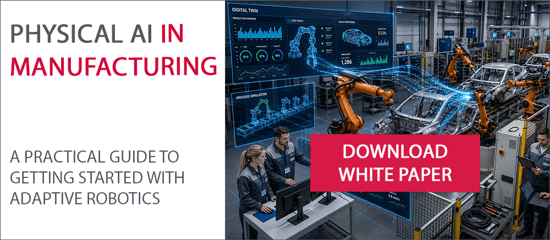
In the accompanying white paper, we expand on this introduction with a suitability check for use cases, a five-step process model, and a KPI framework for economic evaluation.