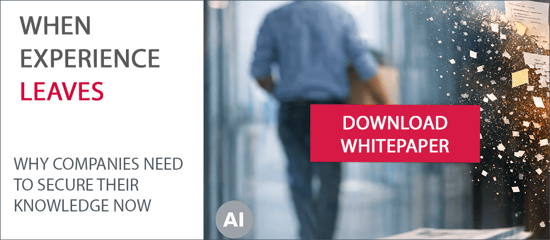


Many companies are unaware of the full extent of the gaps left by the departure of long-serving employees. The term “turnover-induced dementia” describes the gradual loss of experiential knowledge - with noticeable consequences for a company’s quality, speed, and efficiency. But how can knowledge be captured systematically and in a user-friendly way? And then made accessible again? The Smart People experts at EDAG have built a knowledge platform with flexible tools that covers various use cases.
When experienced employees leave a company, retire, or change positions internally, it’s rarely just one employee who disappears. Often, they take with them a part of what actually keeps a company functioning day-to-day: well-established solutions for special cases, an instinct for which decision was the right one in a given situation, and the knowledge of whom to ask when in doubt. This rarely becomes apparent on the last day of work. It becomes evident weeks or months later, when follow-up questions go unanswered, handoffs seem incomplete, and new colleagues take longer to make confident decisions. A striking term has become established in practice to describe this phenomenon: turnover-induced dementia.
“Data Set” vs. “Actionable Knowledge”
In fact, many organizations have more content available than one might assume from day-to-day work. Process descriptions exist, training materials are well-maintained, there are shared drives, wikis, and often a formal knowledge management system as well. Nevertheless, recurring patterns emerge: questions always end up with the same two or three people, information has to be searched for repeatedly, and new employees in knowledge-intensive roles take noticeably longer to make confident decisions. This gives rise to operational risks that must be actively addressed.
The cause of these risks lies in the nature of knowledge itself. Broadly speaking, three levels can be distinguished:
- explicit knowledge, which is documented and therefore relatively easy to transfer;
- implicit experiential knowledge, which manifests itself in routines, error patterns, and decision-making logic and is usually not written down anywhere, and
- contextual knowledge, which links both of the previous levels to the specific situation, role, and system landscape. Ironically, it is precisely the second and third levels—that is, the knowledge that matters most in day-to-day work—that are scarcely represented in traditional documentation.
Effective knowledge management must take all three levels into account. Furthermore, it must find ways to convey the documented knowledge in such a way that new employees can quickly become productive in their roles.
Here lies a dangerous fallacy: a full data repository does not equate to an organizational memory. Many companies believe they are well-positioned because extensive knowledge is stored in numerous systems—including learning platforms, document repositories, ERP, PLM, or MES systems, as well as numerous specialized applications. Yet the larger and more distributed this repository becomes, the more critical its accessibility becomes.
Integrated Knowledge Platform for Input & Output
For EDAG, knowledge management is a crucial component of its Smart People Strategy. This strategy places people—and the maximization of their options for action—at the center of solution approaches, rather than what is technically feasible. Among the elements of this strategy are “making organizational memory usable” and “providing the right knowledge at the right time and in the right place.”
These are addressed by the offerings of the metys Academy. This is an AI-based knowledge management platform that brings together six tools that access a shared knowledge repository.
The target audience includes industry, government, educational institutions, and NGOs—in principle, all companies and organizations that possess valuable domain-specific knowledge that needs to be captured, structured, and shared in a targeted manner, or that have areas with critical, person-specific knowledge and, accordingly, a high need for training and knowledge transfer.
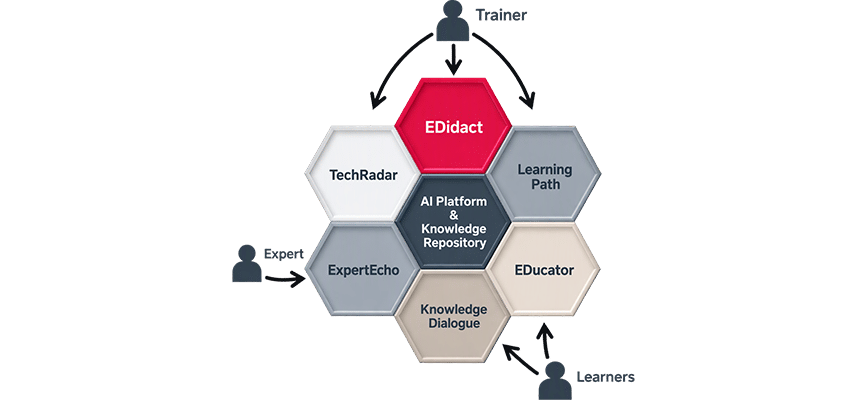
The Tools in Detail
1. TechRadar
TechRadar automatically monitors external sources on predefined topics: websites, intranets, the education market, and trade journals. The application identifies technology trends and uses them to determine training needs. Users receive relevant literature and websites at irregular intervals—such as weekly or every two days—but can also specify specific topics for additional searches. The application runs in the background and requires no active research. Users review the suggestions at their convenience, rather than having to search for them themselves.
2. ExpertEcho
ExpertEcho captures internal experiential knowledge before it is lost to the company: when employees leave, after projects are completed, or when someone wants to actively share their knowledge. Instead of relying on forms or input screens—which many users find daunting—the tool uses AI-guided interviews lasting up to 25 minutes on one or more pre-selected topics.
The AI interviewer ensures that the experts do not stray from the topic during their responses but remain focused on the respective subject, and asks follow-up questions to fill in any identified “gaps.” This allows processes to be documented during the conversation and linked to all relevant information.
The result is a summary that the interviewee reviews, edits if necessary, and finally approves before it is added to the knowledge base.
3. Learning Path Generation
Learning path generation compares existing competencies with required ones and determines which training courses a person must complete to progress from one competency level to the next. It highlights gaps in the existing training offerings before new content is created. The results are directly incorporated into the creation of new training courses via the EDidact tool, preventing the development of training courses that already exist or that no one needs.
4. EDidact
EDidact converts existing material—such as operating manuals, presentations, slide decks, and even images—into structured training formats. A wide range of options is available: simple outlines, complete presentations, or interactive web-based training (WBT) with interim questions, videos, matching exercises, and even a final test. Trainers specify the topic, target audience—such as the foreman’s office, plant operators, team leaders, or the trainers themselves—language, language proficiency level, and, for web-based training, the preferred learning style.
EDidact automatically translates this information into the training content without requiring users to formulate a prompt themselves. An initial result is available within a few minutes and typically covers about 70 to 80 percent of the content. An integrated editor also allows users to swap out images or adjust answers within the WBT. In other words, training content creators don’t start with a blank page, but with an editable draft that they simply refine.
5. EDucator
Content approved in EDidact is available to learners in EDucator. An integrated chatbot answers additional questions from learners during the training. The chatbot accesses the entire knowledge database, explains complex topics in an understandable way, and searches the learning materials as needed. This means learners do not have to interrupt the training and search elsewhere if something remains unclear to them. If a question cannot be answered using the learning materials alone, the chatbot explicitly asks whether it should expand its search scope, which significantly improves the reliability of the answer (keyword: hallucinations).
6. Knowledge Dialogue
Knowledge Dialogue replaces static tests with an oral exam. The AI is provided with a reference document—such as a code of conduct for annual compliance training—and uses dialogue to assess what the respondent has internalized from it. If the responses are confident, the conversation ends after a few minutes.
If the learner is unsure, the AI points to the relevant sections in the document, allowing the learner to familiarize themselves with the content once more. The interview then continues. This format helps prevent recurring mandatory training sessions—with the same slides and the same questions—from ultimately losing their effectiveness.
Focus on User Motivation
The six applications flexibly cover different phases of the same cycle. TechRadar and ExpertEcho populate the central knowledge base from both external and internal sources. The learning path generator then determines the specific needs based on this information. EDidact generates the appropriate content, EDucator makes it available to learners, and Wissensdialog verifies whether the knowledge has actually been retained.
The guiding principle here is a low barrier to entry: Each application requires as little effort as possible to share or acquire knowledge, so that users do not give up because the effort is too great, but rather remain motivated to share or acquire knowledge.
Intellectual Property Protection Guaranteed
The metys Academy is based on various EDAG technologies used across different business units. A key component is the underlying AI. Instead of training its own LLM, EDAG uses Retrieval Augmented Generation (RAG). In this approach, the base model remains unchanged but gains access to internal knowledge databases where project-specific information is dropped. Both licensed commercial LLMs and open-source variants can serve as base models, thereby preventing technology lock-in.
This allows any interested company to set up its own knowledge platform. The open platform can be hosted at the EDAG data center in Fulda or, as part of a partnership, at T-Systems. The Deutsche Telekom subsidiary also enables cloud hosting across European borders.
Part of the Industrial Metaverse
The metys Academy is just one part of the Industrial Metaverse platform that EDAG has developed under the name metys. It breaks down data silos and connects existing systems and data sources from design (CAD), product lifecycle management (PLM), ERP, simulation, and production into a single database, thereby creating a digital space where products, production processes, and the associated data can be analysed across the entire lifecycle of a factory.
metys thus exemplifies the principle that also underlies the knowledge platform described here in the “Smart People” domain: integrating different data sources both technically and organizationally. For more information, visit www.edag.com/de/metys .
Are you also looking for ways to better preserve experiential knowledge and make training programs more efficient? Then speak with our Smart People expert, Frank Breitenbach. Or download our white paper “Combating Staff Turnover-Induced Knowledge Loss” right here. There you’ll find further technical details about the platform as well as step-by-step instructions on how to implement the concept in your own company.