



When a small or medium-sized enterprise (SME) automates a process for the first time—such as integrating its first robot into production—the challenge is less technical than it is human. Production managers who have been responsible for the same assembly process for years are suddenly faced with a decision for which they have no benchmarks. CEOs are evaluating an investment whose return on investment (ROI) cannot be easily calculated. Employees wonder what the change means for them. And somewhere within this web of uncertainty, expectation, and responsibility lies the real question: Where do we start?
The most important points at a glance:
- The first implementation of robotics rarely fails because of the technology
- Unclear economic viability, lack of experience, data gaps, and insufficient integration expertise hold back small and medium-sized enterprises (SMEs) from adopting automation and robotics
- A real-world example from final assembly in the rail infrastructure sector shows how a structured approach overcomes these barriers
- Crucial: The choice of technology follows the process, not the other way around
What hurdles must SMEs overcome to successfully enter the world of automation?
In discussions about automation, questions regarding cost-effectiveness and technical feasibility often dominate among executive and production management. These questions are valid and important.
However, what often holds SMEs back from adopting automation is the lack of an economic assessment based on real process data. There is a lack of reliable information on which processes can be meaningfully automated, what level of effort is realistic, and what economic benefits automation actually delivers. Without this foundation, the decision remains uncertain.
In practice, four barriers emerge that slow down the transition:
- Unclear economic viability: When will the investment pay off? Without reliable process metrics, this question remains unanswered and often prevents a decision from being made.
- Lack of experience: Automation—especially robotics—is not part of everyday production at many SMEs. There is a lack of internal reference projects, benchmarks, and an assessment of which processes can be automated cost-effectively.
- Data gap: Processes that have been functioning for years are not fully documented. Cycle times, component geometries, interfaces, and knowledge of variants exist primarily in the minds of experienced employees. Anyone who wants to evaluate automation thoroughly needs this information. Companies often have to systematically collect it first.
- Integration gap: Automating a manufacturing process means bringing together robotics, image processing, sensors, software, and engineering. This integration expertise is rarely fully available in-house at SMEs.
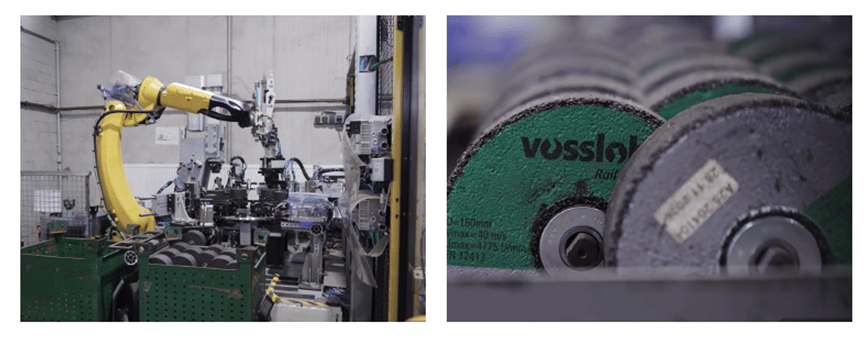
Assembly Automation in Practice: The First Robot at Vossloh in Veddel
Vossloh AG, headquartered in Werdohl, is one of the world’s leading rail infrastructure companies. Several robots operate in its modern, fully automated production facility. The situation was quite different at its subsidiary, Vossloh Rail Services Deutschland GmbH, in Veddel: Until then, no robots had been used there. The team had little experience with automation. An assembly process that had been performed manually for years needed to be optimized. This process was monotonous and was subjectively perceived by employees as ergonomically straining. Since there was no comprehensive quality inspection, batch variations were not consistently detected.
The process itself was not complex. A robot was to take out grinding stones from mesh boxes, assemble an axle with two ball bearings, and perform a quality inspection in the process. What made the project difficult were not the assembly steps, but the operating conditions: The components arrived in a disorganized manner. There was no defined positioning. Furthermore, this was the first time a robot was to be used at this location at all.
What followed was not a technology project. It was a structured engineering endeavor with a clear sequence of steps. First, the process was analyzed; then feasibility was assessed, and cost-effectiveness was demonstrated through a structured cost-benefit analysis. A solution was then developed. Only after this step were the technology decisions made.
The result is a fully automated final assembly line with AI-supported image processing. This enables 100 percent quality inspection, a 30 percent increase in output, and improved productivity. McKinsey has demonstrated across industries that such results can be achieved: Companies that successfully implement automation and robotics increase throughput and productivity by 10 to 30 percent.1
Sergej Lemke, a quality and production engineer at Vossloh Rail Services Germany, confirms: Vossloh’s Veddel facility now operates more efficiently, process quality is more consistent, and automation has simultaneously marked the first step toward robotics integration.
Introducing Robotics into Manufacturing: The First Step Is Smaller Than It Seems
The key to the project with Vossloh Rail Services Germany is the starting point. Vossloh did not begin with a comprehensive automation strategy at its Veddel plant. The company started with a suitable process and a partner who understood that process before proposing a solution. Analysis, evaluation, concept, implementation: in that order.
Those who systematically analyse their own production to identify which tasks are repetitive, manual, and measurable often recognize opportunities for improvement faster than expected.
Read more: A Structured Approach to Automation
Our white paper describes how companies systematically identify and evaluate automation potential, the steps a project goes through from concept to commissioning, and the details of the assembly project with Vossloh.
The outlook also shows that those who take a structured approach to automation today are simultaneously laying the foundation for the future: systems that not only automate but also perceive, learn, and make decisions in real time—Physical AI.2
Do you have questions about automation potential in your production? Johannes Schafsteck, Business Development Smart Factory at EDAG PS, would be happy to schedule an initial consultation with you.
The white paper is aimed at CEOs and production managers of SMEs who wish to conduct a thorough assessment of automation potential within their companies.
Download the white paper for free now: “Where Does Automation Make Sense in Your Production?”
[1] Capgemini Research Institute: Physical AI – Taking human-robot collaboration to the next level, 2026. Survey period: January–February 2026, n = 1,678 executives from industrial companies worldwide. Online, accessed on April 28, 2026