




















In connected industrial environments today, terabytes of data are generated every day. But is this data being used effectively? Far too often, the answer is no. The reasons are varied: The data resides in isolated sources, is not available in real time, or is not formatted in a way that allows humans to work with it. But this can be changed—softlab is leading the way.
Industrial manufacturing today is largely digitized and networked. A broad system landscape captures workpieces and production materials, machine statuses, process flows, and environmental data. The data comes from PDM, MES, and ERP systems, quality and service tools, sensors, and control systems. In theory, this data forms the basis for optimal decisions.
But the reality is different. When data ends up in isolated silos, it may not be available at all when it’s needed most. Or no actionable insights can be derived from the data because the context is missing. Or the data must first be laboriously converted—possibly through (partially) manual processes—into a format that allows for further processing, which inevitably causes a time delay.
How Data Becomes Information
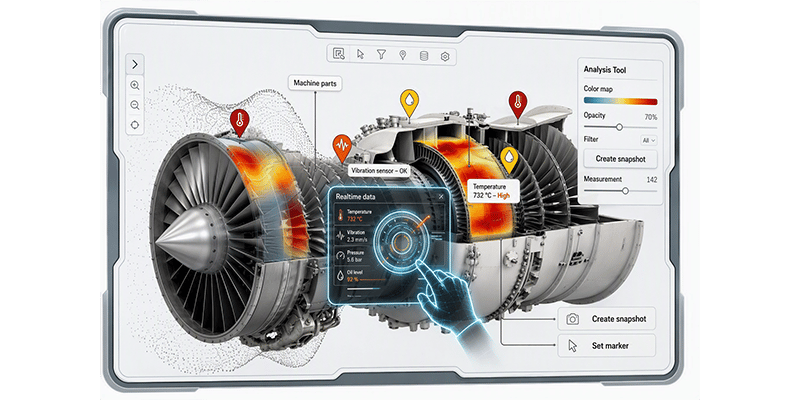
A look inside a factory floor illustrates where the problems currently lie. Take, for example, the manufacturing of a high-performance gas turbine. Various errors occur during the production process. One of them occurs more frequently than all the others, though not on a regular basis. When reviewing the problem cases—which are available as numbers or text-based status messages—no pattern is immediately apparent; the clustering of these errors gets lost in the statistical noise.
The result: The cause of the error remains unaddressed, and gas turbine production is less efficient than it could be because manual rework is repeatedly required, incurring significant costs over the course of the fiscal year.
With appropriate data processing, however, these hidden problems can be made visible—in the truest sense of the word. A digital twin, converted into a 3D representation, provides the foundation for this. Through a heat map that highlights clusters of errors with color, as well as data point clouds that visualize outliers, the existing but previously overlooked data suddenly becomes valuable information that enables better-quality decisions to be made.
The Big Misconception
This example shows that more data isn’t always necessary. In most cases, the data is already available—though often not in a suitable format. Nor is the solution simply to build more dashboards. In reality, that merely shifts the complexity to the surface.
The goal must be to deliver the right information to the right place at the right time. A crucial factor here is whether the presentation does justice to the decision-making context. A worker in the paint shop needs different information than a production manager in a shift meeting or a service technician in the field. Three aspects determine whether data is actually effective:
- Integration: Data sources from PDM, MES, ERP, and quality management must be consolidated via secure, scalable interfaces.
- Spatial Context: Complex technical issues only become understandable when they can be situated within the real-world geometry of a plant, a component, or a process—via 3D visualization, digital twins, or VR/AR.
- User-Centricity: User interfaces must be designed so that the information guides action without requiring extensive training.
Only when these three dimensions come together does data become a tool for decision-making.
Help from External Partners
Effectively combining these three dimensions in a user-friendly way is a real challenge. It can be worthwhile to bring in external partners for support—partners who, with their experience and specific expertise, can quickly arrive at viable solutions.
One such partner is softlab, the software team within Feynsinn, a brand of the EDAG Group.
This allows softlab to excel in three key areas:
- Development expertise: In-depth know-how in the latest technologies for software programming, interface development, and the design of intuitive user interfaces;
- System expertise: A comprehensive understanding of existing authoring systems, such as CATIA, and system landscapes comprising PDM, MES, and ERP systems—among many others—as well as the data generated by them, including its context;
- Domain expertise: The knowledge of how an industry operates, which specific processes are used there, and what the particular requirements and challenges are.
This outstanding combination, paired with expertise gained from numerous successfully implemented projects, enables softlab specialists to provide the right data, link it to meaningful insights, and translate it into intuitive interfaces that support decision-makers at various levels precisely in their respective roles.
How to Unlock Your Data Treasures
On the one hand, the challenges faced by various industrial sectors—whether automotive manufacturers, producers of consumer goods, medical technology companies, or manufacturers of many other product groups—are essentially similar time and again. On the other hand, industry-specific solutions are still needed to meet the respective user requirements.
To address this, softlab has developed a flexible process model. This model tackles the most common problems in software projects within industrial environments, such as unclear use cases, a lack of validation, and a gap between pilot and scaling. At the same time, it leaves room for industry- and customer-specific solutions. The model consists of four steps:
- Identifying potential and developing use cases—in collaboration with business units, closely aligned with real-world work processes.
- Validation of the concept—quickly and robustly, before development budget is committed.
- Development of the digital solution—using modern architectures, clean interface design, and short iteration cycles.
- Implementation, operation, and scaling—including handover to line management, monitoring, and ongoing development during live operation.
This results in solutions that deliver value in day-to-day operations. The foundation is an end-to-end data flow from the shop floor all the way to management meetings. Based on this, user interfaces are created where each level sees exactly what it needs to see. And most importantly: all levels are working with the same, up-to-date, high-quality data, ensuring everyone is on the same page.
Are you also struggling with scattered data and information gaps among decision-makers? Are you interested in learning how to unlock your hidden data treasures to boost production efficiency and avoid unnecessary costs? Then speak with Michael Vogel, softLab Team Leader at Feynsinn.
Or download our white paper “From Data Silos to High-Quality Decisions” right here. In it, you’ll learn more about the softLab process model and the underlying technology stack, the specific benefits you can expect, and the measurable results achieved in various reference projects.