



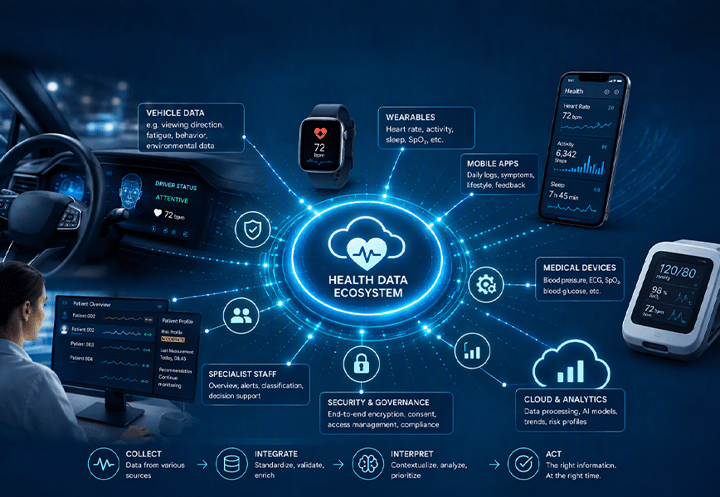
Vital signs are no longer generated solely where MedTech traditionally collects them: in hospitals, doctors’ offices, or on medical devices. They are generated right in the midst of everyday life—on the way to work, in traffic, during an after-work walk, or between appointments. Wearables measure heart rate, activity levels, and other information—for example, from the vehicle’s interior. Additional contextual data—such as driver status detection and driving behavior—enables conclusions to be drawn about fatigue and stress.
The challenge, therefore, lies not in a lack of data, but in placing it in the right context. Many data points exist side by side without yet providing a reliable picture. An elevated heart rate is, at first, just a measurement. Only the context reveals what lies behind it, how the value is changing, and whether action is needed at all. This is precisely where the real task for MedTech begins.
More data alone does not create value
Many companies are already investing in sensors, apps, and cloud connections. Nevertheless, the hoped-for added value often fails to materialize. There is still a long way to go from data collection to information that truly helps in everyday life.
A single wearable with its own app can be impressive in specific situations. In practice, however, viable MedTech solutions, however, require a combination of multiple sources—such as several wearables, device data, and situational context from everyday scenarios. That’s exactly when the gaps come to light:
- Data models do not align.
- Contextual information is missing.
- Alerts are technically correct but not prioritized in a way that users can understand.
- The interface displays values but offers no guidance.
Vital data must therefore not be analysed solely in terms of individual devices. What matters is how a reliable overall picture emerges from individual measurement points.
Why the Vehicle Interior Is an Interesting Testing Ground
The vehicle interior is not a sales market for medical devices, but it is a good stress test. It serves as a real-world testing ground where sensor technology, data processing, and user guidance must function under challenging conditions: while in motion, in real time, and without lengthy explanations.
This is precisely why it’s worth examining this context from a MedTech perspective as well—not because the automotive and medical technology sectors are the same, but because both must grapple with similar fundamental questions:
- How can heterogeneous signals be transformed into a reliable assessment of a person’s condition?
- How can alerts be prioritized so that people can respond appropriately?
- How must a user interface be designed so that it provides guidance in critical situations rather than creating additional stress?
Projects involving driver condition recognition, human action detection, or sensor-based fatigue analysis demonstrate just how universal many of these building blocks are. From a sensor technology perspective, many use cases differ less in the measurement itself than in their subsequent application. Gaze direction, blink rate, gestures, or behavioral patterns can be relevant across various domains. What matters most is how these signals are classified and integrated into a safe process.
Three takeaways for MedTech
1. Without context, vital signs can be misleading
An elevated heart rate is initially ambiguous: it can result from physical activity, situational stress (e.g., in traffic), emotions, or harmless everyday variations. Only the context—such as physical activity, time of day, rest periods, or accompanying events—turns the measured value into a reliable basis for decision-making.
For MedTech, this means that simply collecting everyday data isn’t enough. It must be contextualized. Time of day, activity, rest periods, movement patterns, or accompanying events are not trivial details. They determine whether a measurement is relevant or not.
2. Good systems organize information before displaying it
A dashboard is only helpful if not everything appears equally important at the same time. This is precisely one of the most important lessons from the vehicle interior: It is not the information itself, but rather the notificationand warning logicthat requires clearly defined priority levels and response pathways.
A useful system distinguishes between:
- a non-critical notification
- an anomaly worth observing
- a clear warning requiring action
This prioritization prevents alert fatigue and increases acceptance among drivers. Hiding critical information in a flood of data ultimately makes your product difficult to use.
3. It’s the architecture that turns sensor technology into a product
Many vital signs initiatives fail not because of the idea itself, but because of the day-to-day challenges of integration. Proprietary Bluetooth Low Energy (BLE) profiles, different device classes, and inconsistent data models create friction precisely where scalability should be taking hold.
A viable vital signs ecosystem therefore needs more than just good sensor technology. It needs an architecture that can handle heterogeneity. In practice, this includes:
- Standardized or at least clearly mapped Bluetooth Low Energy profiles
- a gateway that handles pairing, consent, validity checks, and fault tolerance
- A common data model for events, histories, and roles
- Dashboards that combine explainability and prioritization
Ultimately, it is not the number of sensors that creates value, but the reliability of the interpretation.
What Companies Should Clarify First
Anyone who seriously wants to integrate everyday data into medtech products and services should not start with the user interface. A different order makes more sense.
First, a clear use case is needed. What intervention is the goal of supporting? Is it early warning, therapy support, pattern recognition, or better clinical classification?
Next comes the question of architecture. Which sensors and data sources already exist? Where are the gaps between the device, app, gateway, and backend? Which standards are still missing? And how can contextual data be integrated in a way that increases clinical benefit rather than just creating additional complexity?
Only then should the interaction layer follow. Who sees what information? When is a discreet hint sufficient, when is a clear warning needed, and how can a decision be explained in a way that’s easy to understand?
Why This Topic Is Relevant Right Now
Remote monitoring, telemedicine, and data-driven services are increasingly bringing MedTech into users’ everyday lives. This also increases the pressure to not only collect vital signs data technically correctly but also to place it in a reliable context.
Companies that currently integrate data only on an ad hoc basis are quickly building the next generation of data silos. By contrast, those who invest early in a sustainable vital signs ecosystem lay the foundation for better user guidance, more robust analytics, and new offerings across the entire care continuum—from initial diagnosis through hospitalization and rehabilitation to home-based follow-up care.”
The real opportunity, therefore, lies not in the next sensor feature, but in an architecture capable of deriving reliable decisions from distributed, everyday data.
Conclusion
Vital data becomes valuable when it is no longer treated as a collection of isolated data points. MedTech can learn one key lesson from real-world environments such as the vehicle interior: Good systems combine sensor technology, context, prioritization, and interaction in a way that provides people with guidance at the right moment. Those who achieve this aren’t simply developing just another connected device. They’re laying the foundation for a vital signs ecosystem that has an impact beyond individual products.
As a MedTech manufacturer or digital health provider, are you facing the challenge of securely integrating vital data from wearables and vehicle interiors and transforming it into actionable dashboards? Talk to our experts Michael Kelnberger, Sales Manager, Technical Sales, and Michael Hayer, Senior Project Manager, at EDAG Engineering GmbH.
The white paper “From the Vehicle Interior to the Vital Signs Ecosystem” provides an in-depth look at what such a target architecture might look like in practice. It includes an architectural blueprint for medtech companies, a pragmatic process model, and a readiness checklist for the next steps.
Download it now!