


















For years, smart products have been seen as a source of hope for new business models, additional services, and better customer experiences. At the same time, pressure is mounting: product life cycles are becoming shorter, global competitors are entering the market, and sustainability is becoming a requirement rather than an option. The key question is therefore no longer whether companies need to further develop their products and business models, but how. For many companies, it is now becoming clear that traditional development logic is reaching its limits. Digital and networked functions only unfold their value when the business model, technology, and user needs are considered together. Individual features are not enough. The decisive factor is the role the product plays in the interplay between technology, organization, and use.
This raises the next question. What role does the product itself play in this transformation?
From product to business model and on to ecosystem
Smart products are more than just networked hardware with complementary software. They are becoming key drivers for new business models and are often even a prerequisite for them today. Many companies are faced with the challenge of further developing their existing business model and focusing more strongly on data-based services.
Instead of selling a product once, recurring revenues, additional service offerings, and models such as Product as a Service are coming to the fore. The decisive factor here is not a single feature, but the ability to build a coherent ecosystem of services, platforms, and data-driven offerings around the product. A feature can be copied quickly, but a functioning interaction between hardware, software, service, and data can hardly be replicated.
Time pressure: Product life cycles are shrinking by almost half
In many areas, such as consumer electronics, product life cycles have shortened dramatically. New generations are coming onto the market faster and faster, and customers expect updates rather than perceiving them as a bonus.
For companies, this means
- more development cycles in less time
- greater complexity due to software, networking, and new services
- simultaneously increasing cost pressure
- Components that are specifically designed for replacement and remanufacturing
- Business models in which the product remains the property of the manufacturer and is operated as a service
- The use of a digital product passport that transparently documents materials, usage, and condition
No company can cope with this development on its own. Service providers, technology partners, and specialized ecosystems are becoming the decisive lever for bringing together speed, quality, and cost-effectiveness. It is important that partners do not just act as an extended workbench, but understand the customer's business model and align their services with the respective stage of transformation – from networked products to data-driven service portfolios.
The more connected and service-oriented products become, the more important it is to maintain a focus on simple and reliable use. Even technically sophisticated solutions only reveal their value if they remain understandable and practical in everyday use.
Smart does not mean complicated, but usable
A common misconception in the discussion about smart products is the assumption that more technology automatically generates more benefits. In reality, technical feasibility is rarely the actual limit. The limit usually lies where user acceptance declines. The decisive factor is not how many functions a product has, but how well it meets everyday needs and how smoothly the interaction works.
A smart product is convincing when it makes life easier for people and simplifies situations. Clear user guidance, understandable interactions, and immediately comprehensible added value are more important than additional features. Precisely because smart products are technically complex, they must be particularly intuitive on the surface. Otherwise, the impression quickly arises that the technology burdens everyday life rather than improving it.
Successful concepts therefore deliberately conceal their complexity. Sensors, connectivity, algorithms, and data flows run in the background, while the product gives the impression of being self-evident to the outside world. This simplicity is no coincidence, but the result of a high level of engineering effort. It shows that smart does not mean pushing a product to the limits of what is technically possible. Smart means designing it in such a way that it fits organically into the world of life and work.
Sustainability as a business case rather than a compulsory exercise
The topic of sustainability also gives rise to areas of tension. Between regulatory requirements, social expectations, and economic constraints, companies must find solutions that go beyond mere compliance with the law. The central task is to make sustainability a viable part of the business model.
One approach is to design products from the outset so that they can go through several life cycles, including return, refurbishment, and reuse. Examples include:
This creates a new form of value creation. Repair, upgrade, and reuse become the business model itself. It is crucial that these approaches are economically viable and create real benefits for customers.
Sustainability inevitably touches on issues such as global competitiveness and the question of how companies can future-proof their expertise. After all, the more closely products are monitored throughout their entire life cycle, the more important it becomes to manage processes, data, and development knowledge consistently.
Globalization, expertise, and long-term competitiveness
In recent decades, many industries have relocated parts of their core knowledge abroad, often for cost reasons. Some races are difficult to catch up on. At the same time, companies' own digital transformation is opening up new options. Repeatable activities can be mapped more efficiently through automation and AI. Processes become describable and scalable, regardless of location. Engineering costs can be reduced through leaner organization, better data bases, and virtual methods.
Five levers for companies on the path to smart products
These developments give rise to five areas of action that are particularly relevant for companies on the path to smart products. They form the framework for the targeted further development of technology, organization, and business models.
- Sharpen and further develop your business model
The development of a smart product should never be an end in itself. The starting point is the question of where the company will really earn money in the future. Value pools, services, data, and ecosystems must be consciously analyzed and prioritized. - Develop products consistently with a customer-centric approach
A purely engineering perspective is no longer sufficient. Interdisciplinary teams from development, business, production, sales, and UX ensure that functions are geared toward actual benefits. - Transform processes and organization
Complex hierarchies and time-consuming approvals slow down innovation. Lean, cross-functional teams and a high degree of parallelization in development become a competitive advantage. - Understanding IT and data landscape as the backbone
Without a consistent database, many ideas remain fragmented. Connecting data from development, production, operations, and service creates the foundation for circular models, predictive services, and continuous product improvement. - Actively shaping partner networks
Hardly any company can cover all areas of expertise itself. It is crucial to build a suitable ecosystem of technology, development, and consulting partners that supports everything from strategy to testing, from hardware to the cloud.
EDAG as a partner on the path to smart products
Smart products are not created by individual features, but by the interaction of engineering, software, data, and a clear idea of the benefits a product should bring to everyday life. It is precisely at this interface that EDAG supports companies in further developing their products and implementing viable smart product concepts.
With experience in hardware development, digitalization, software architectures, and intelligent production, we accompany you every step of the way: from early strategic classification and technical implementation to integration into existing processes and systems. It's not just about using technologies, but about designing products that are technically resilient, economically viable, and generate real added value for users as future-proof smart products.
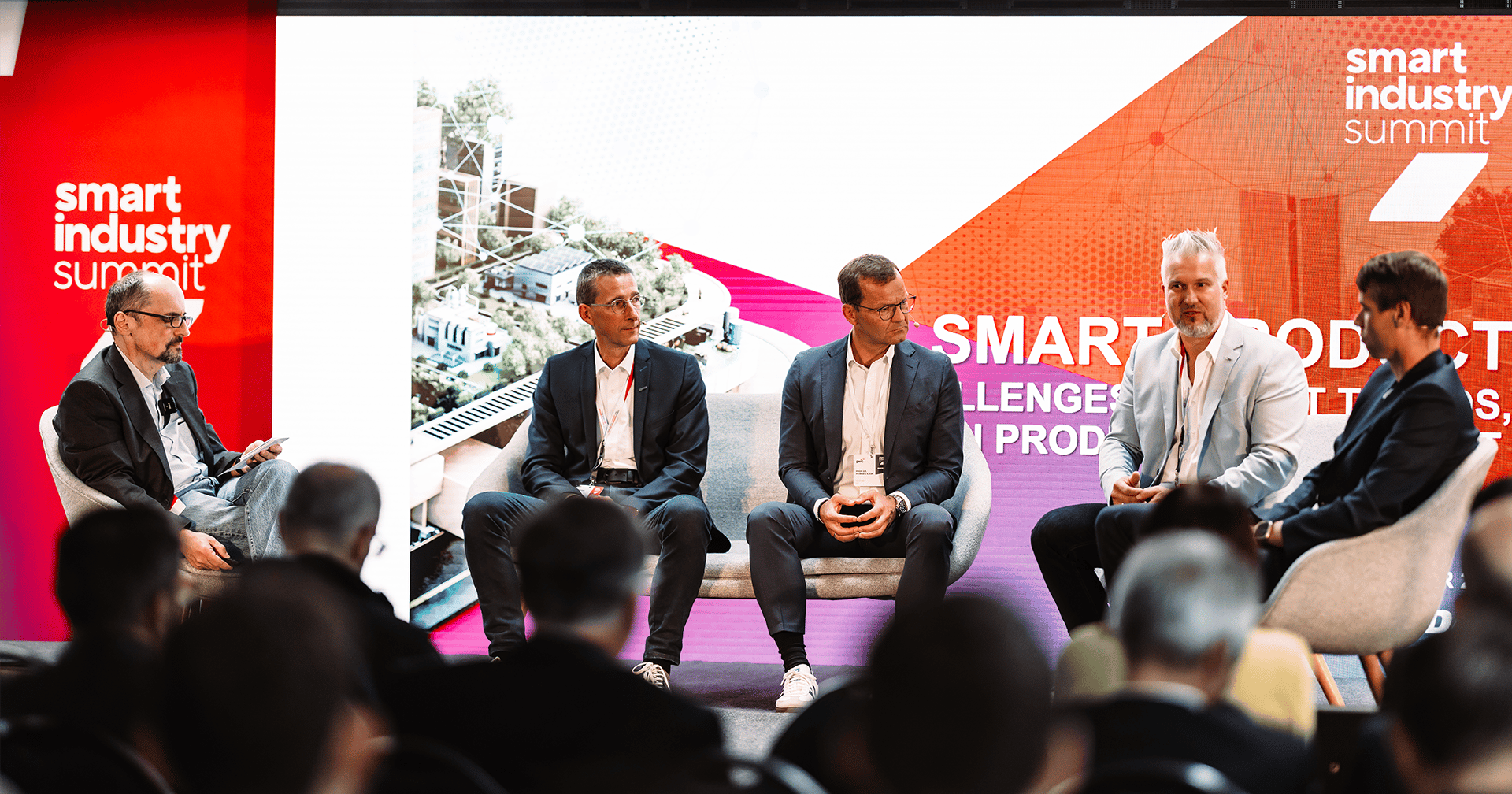
Want to dive deeper? Watch the recording of the "Smart Product" Couchtalk
Further exciting insights and perspectives from our experts on smart products, new business models, sustainability, and ecosystems can be found in the recording of the EDAG Couchtalk "Smart Product."
Participants in the Couchtalk:
- Prof. Dr. Florian Kauf (Partner Operations, PWC)
- Jörg Hülsmann (Vice President CAE & Vehicle Safety, EDAG)
- Heiko Herchet (Vice President Digital Transformation, EDAG)
- Alex Paldus (Vice President E/E, EDAG)
- Dr. Frank Breitenbach (Moderator, EDAG)
Do you have any questions? Please contact our colleagues Heiko Herchet and Dr. Frank Breitenbach.